programming
What is a program?#
A computer is a tool for solving problems with data.
A program is a sequence of instructions that tell a computer how to do a task. When a computer follows the instructions in a program, we say it executes the program. You can think of it like a recipe that tells you how to make a peanut butter sandwich. In this model, you are the computer, making a sandwich is the task, and the recipe is the program that tells you how to execute the task.
Activity:#
Come up with a sequence of instructions to tell someone how to make a peanut butter sandwich. Don't leave any steps out, or put them in the wrong order. Was that easy? Did you remember all the steps? Maybe you forgot to tell me to use a knife to spread the peanut butter. Now I've got peanut butter all over my hands! Of course, you say, a person wouldn't be that dumb. But a computer is that dumb. A computer will only do what you tell it to do. This might make programming frustrating at first, but it's relieving in a way: if you do everything right, you know exactly what the computer is going to do, because you told it.
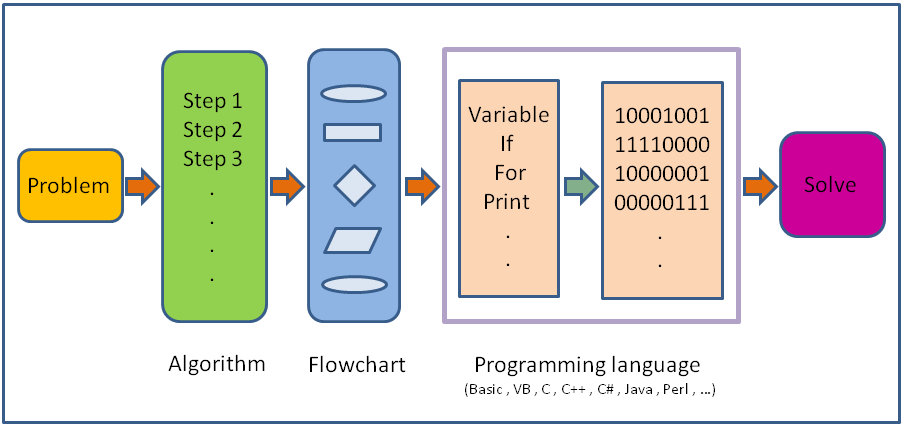
Of course, computers don't understand recipes written on paper. Computers are machines, and at the most basic level, they are a collection of switches—where 1 represents "on" and 0 represents "off". Everything that a computer does is implemented in this most basic of all numbering systems—binary. If you really wanted to tell a computer what to do directly, you'd have to talk to it in binary, giving it coded sequences of 1s and 0s that tell it which instructions to execute. However, this is nearly impossible. In practice, we use a programming language.

with algorithm and flowchart for solving problem:
What is a programming language?#
A programming language is, as the name would suggest, a language developed to express programs. All computers have a native programming language that they understand, commonly referred to as machine code. However, machine code is a difficult language for us to follow: amongst a number of difficulties, it is typically expressed in the binary number system, and it is unique to a particular computer architecture (thus two different computers could potentially use two different versions of machine code). Other programming languages, such as Assembly, BASIC, Java and C++ exist to provide a better interface between us, as the programmers, and the computer, by allowing programs to be expressed in a language that is easier for us to understand and potentially common to a number of computer architectures, but which can still be translated into machine code. In order for this to happen, a computer must either compile or interpret programs written in one of these languages before they can be executed.